Early warning for lensed gravitational wave counterparts from time delays of their host galaxies observed in the optical
Authors: Sourabh Magare, Anupreeta More, Shasvath Kapadia
Journal: Preprint , Year: 2025

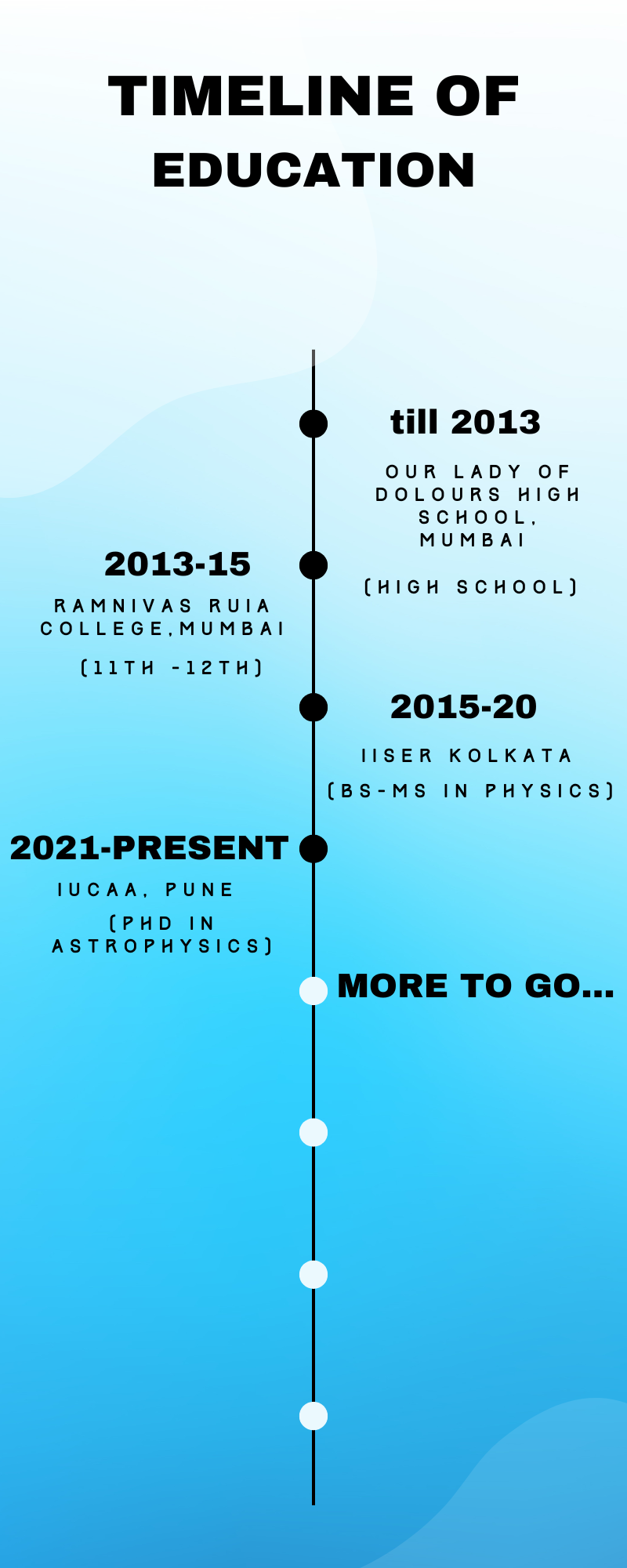
Hi! I am a research scholar at Inter University Center for Astronomy and Astrophysics (IUCAA), Pune.
My current research is broadly focused on Gravitational lensing, Gravitational waves and Multimessenger Astronomy.
Authors: Sourabh Magare, Anupreeta More, Shasvath Kapadia
Journal: Preprint , Year: 2025
Authors: Sourabh Magare, Anupreeta More, Sunil Choudhary
Journal: Monthly Notices of the Royal Astronomical Society , Year: 2024
Authors: Sourabh Magare, Shasvath J Kapadia, Anupreeta More, Mukesh Kumar Singh, Parameswaran Ajith, AN Ramprakash
Journal: The Astrophysical Journal Letters, Year: 2023
Authors: Abhinash Kumar Roy, Sourabh Magare, Varun Srivastava, Prasanta K Panigrahi
Journal: Quantum Reports, Year: 2022
Authors: Sourabh Magare, Abhinash Kumar Roy, Varun Srivastava
Journal: European Journal of Physics, Year: 2022
GW170817 was a 'superstar' event. It was a merger between 2 neutron stars which was detected by Gravitational wave (GW) detectors of LIGO-Virgo Collaboration.
Furthermore, after the 2 seconds Gamma rays were detected from the same region of sky and it was established that we have seen the Electromagnetic (EM) counterpart of a GW event.
A follow-up search of the same region of sky revealed a Kilo-Nova, which is the remant of the Binary Neutron Star (BNS) merger. Using this multi-messenger data of GWs and EM, we
made some fundamental discoveries like putting constraints on the mass of Graviton, Constriants of Lorentz invariance and also fascinating discoveries in Astrophysics like
binary neutron star mergers are sources of short gamma ray bursts and, neutron star mergers as source of s- and r- process of nucleosythesis.
However, we observed this event through EM telescopes after the neutron stars have merged i.e. in the post-merger phase. Can we observe such an event even before it is
merged?
To observe the premerger implies that we should know the sky-location of the event even before the event has occured. In this work, we show a novel approach to capture the Electromagnetic
counterpart of BNS or Neutron star - Black hole (NSBH) mergers with an early warning time of hours and days before the merger, provided the event is strongly lensed. This is orders if magnitude larger than the early warning time we have from the GW low latency piplines.
The idea is that suppose we detect GWs from a BNS/NSBH event. Then, similar to GW170817 by the EM follow-up, we localize host galaxy of the source. If we find that this galaxy is strongly lensed i.e. we observe multiple images of the same galaxy because of gravitaional lensing by an intervening galaxy.
Then from the positions of the images of the host galaxy, we can calculate the time-delay between the next images. Now, we know the time when the next image from the merger of BNS/NSBH will reach us and it will be the action replay of the original event.
We just wait and capture that action replay!!
In this work, we trained a neural network on Q-transform images and Sine-Gaussian images of Gravitational wave (GW) data to distinguish between a pair of lensed GWs and unlensed GWs
. We showed that including the Sine-Gaussian maps with Q-transform maps results in a better efficiency than analysing QT maps alone. We also evaluate the performance of our network on real detected GW events detected by LIGO-Virgo collaboration (till O3) and find that our network correctly classifies all of
them as unlensed GWs, which is consistent with non-detection of GW lensing.